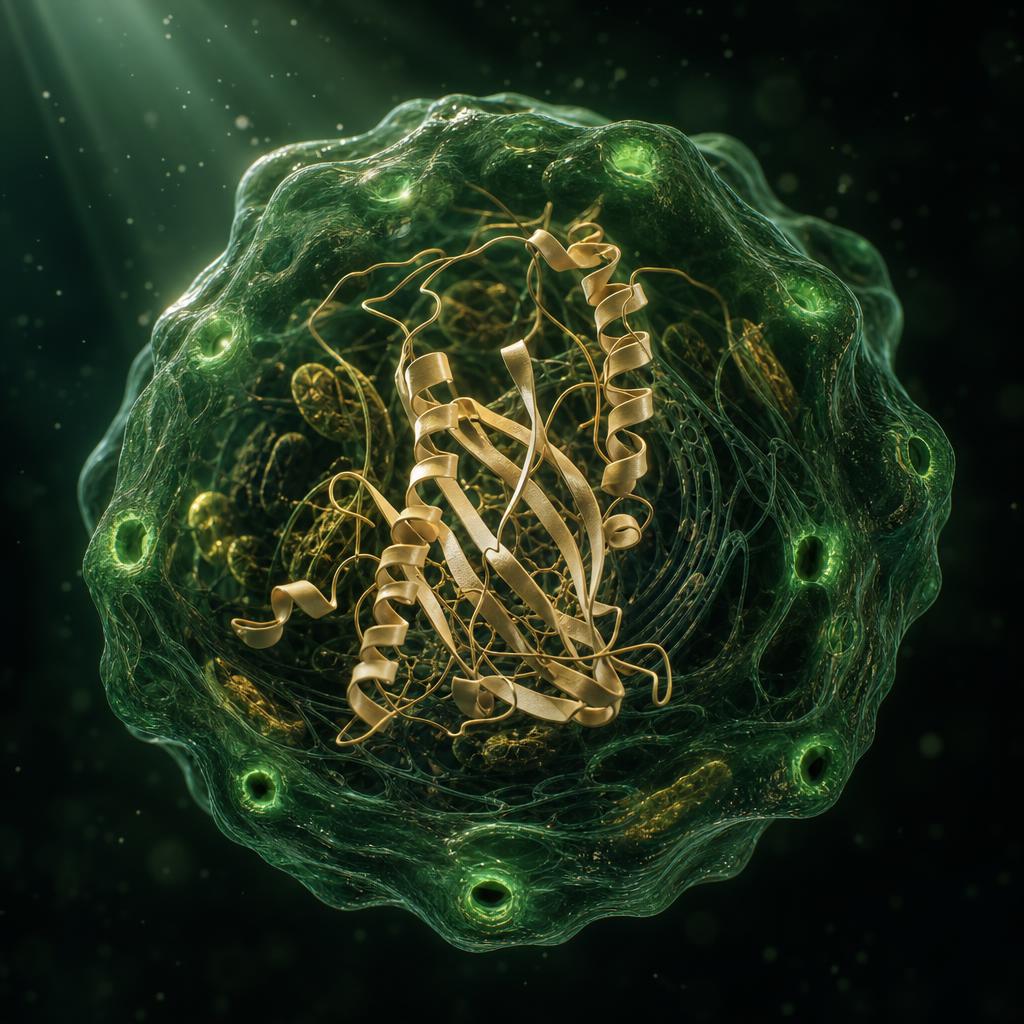
Mutation-aware p53 rescue from structure to scored ligand.
Enter a TP53 mutation. Compare curated or custom PDBs with an ESMFold mutant model, inspect WT overlays and cryptic pockets, dock curated ligands in-browser, and export the full screen as organized JSON.
More than half of human tumors carry TP53 mutations. Restoring wild-type function is one of oncology's highest-stakes targets.
HyperLab53 consolidates mutation entry, catalog or custom PDB selection, ESMFold mutant prediction, CORS-safe Mol* visualization, WT overlays, cryptic-pocket detection, top-N ligand docking, uncertainty scoring, and JSON screen export into a single browser-based interface.
The problem, the gap, and what HyperLab53 actually does about it.
TP53 is mutated in over half of human tumors, yet direct reactivators remain rare and mutation-specific. Traditional discovery for a single p53 variant takes years of assay design, structural work and screening before a mechanistic story emerges. HyperLab53 is not a replacement for a wet-lab campaign — it is a transparent, browser-native front end that collapses the mutation → structure → pocket → ranked ligand loop into a single session, and shows its work at every step.
One mutation, one target, years of setup.
Each p53 hotspot (R175H, R248Q, R273H, Y220C, R282W…) has a distinct destabilisation and pocket signature. Standard pipelines rebuild the structural and screening context from scratch per variant.
Pathogenicity scores don't tell you what to try.
AlphaMissense / SIFT-style scores label a variant as damaging without pointing to which structural motif to rescue or which class of ligand to prioritise.
Mutation-aware, mechanistic, and honest.
ESMFold mutant + WT overlay + cryptic pockets, in-browser docking of curated rescuers and vetted approved compounds, SAE-based motif attribution, calibrated uncertainty bands, and DMS overlays — all exported as JSON.
Same target. Different loop.
Illustrative comparison of the practical experience of working a p53 mutant, not a benchmark of clinical outcomes. HyperLab53 accelerates hypothesis generation; wet-lab validation still lives downstream.
- Starting point for a p53 mutantTraditionalAssay design, HTS deck, crystallography or MD — months to years before the first mechanistic read-out.HyperLab53Enter a TP53 change (e.g. R175H, Y220C) and get a mutation-aware ESMFold model, WT overlay, cryptic pockets and dockable receptors in one screen.
- Compound libraryTraditionalProprietary decks of new chemical entities with unknown safety profiles.HyperLab532,700+ vetted ChEMBL Phase-4 compounds and a curated rescue set (APR-246, PC14586, PK083, COTI-2, ZMC1, ATO…) — molecules with real human exposure data.
- DockingTraditionalCluster-side AutoDock/Vina jobs, GPU queues, licence servers, IT tickets.HyperLab53RDKit-WASM + local physics scoring runs in the browser tab. You can point it at a catalog PDB, an ESMFold mutant model, or a PDB/CIF you upload yourself — no external docking cluster, no job queue.
- Mechanistic insightTraditionalPathogenicity score from AlphaMissense / SIFT / PolyPhen — one number, no motif-level detail.HyperLab53Curated SAE-derived motif profiles (DBD hydrophobic core, L2/L3 zinc coordination, DNA-contact loop) map each hotspot mutation to the structural elements it disrupts, alongside per-residue ΔΔG. Profiles are static per hotspot variant — not live SAE inference.
- Experimental groundingTraditionalInternal cell assays, not shared.HyperLab53Public deep-mutational-scanning data (Giacomelli 2018 TP53 DMS) overlaid on the same residue view as the prediction — the model is checked against measured fitness in the same UI.
- UncertaintyTraditionalA single score, no calibration.HyperLab53ONNX ensemble with isotonic calibration reports a probability, a Bessel-corrected σ, and a low/medium/high confidence band on every hit.
- ReproducibilityTraditionalProprietary pipelines, screenshot-only reports.HyperLab53Every visible card — mutation metadata, structures, pockets, docking scores, references — exports to a single structured JSON file.
From mutation to rescue candidate
Eight integrated stages, one continuous workflow. Every step is designed for cancer biologists — not computational chemists.
Mutation input
Enter a TP53 protein change or upload a catalog file; the app keeps only variants that can be structurally folded and docked.
Catalog, custom PDB, or ESMFold
Choose an experimental PDB, upload a private PDB/CIF, or generate a mutation-aware ESMFold model when the selected structure is not suitable.
CORS-safe Mol* visualization
Mol* renders the selected receptor, waits for the target node before WT overlays, and keeps visualization working even when optional volume servers are blocked.
WT overlay + cryptic pockets
Kabsch RMSD, per-residue displacement, and a geometric grid-scan pocket finder (including metal cofactors) reveal structural rescue opportunities around the mutation site.
In-browser docking
RDKit-WASM builds ligand geometry and local physics scoring docks poses directly in the tab. The receptor can be a catalog PDB, an ESMFold mutant, or your own uploaded PDB/CIF — the docking step itself never leaves the browser.
Curated top-N docking
Mutation-matched rescue ligands and positive controls can be docked sequentially, ranked by best pocket energy, and reloaded into the 3D viewer.
Calibrated ML scoring
Rescue-vs-inhibit scoring reports transparent features, uncertainty bands, and model calibration rather than a single opaque number.
Structured export
The full visible lab screen exports as organized JSON with mutation metadata, card values, tables, links, docking scores, and provenance.
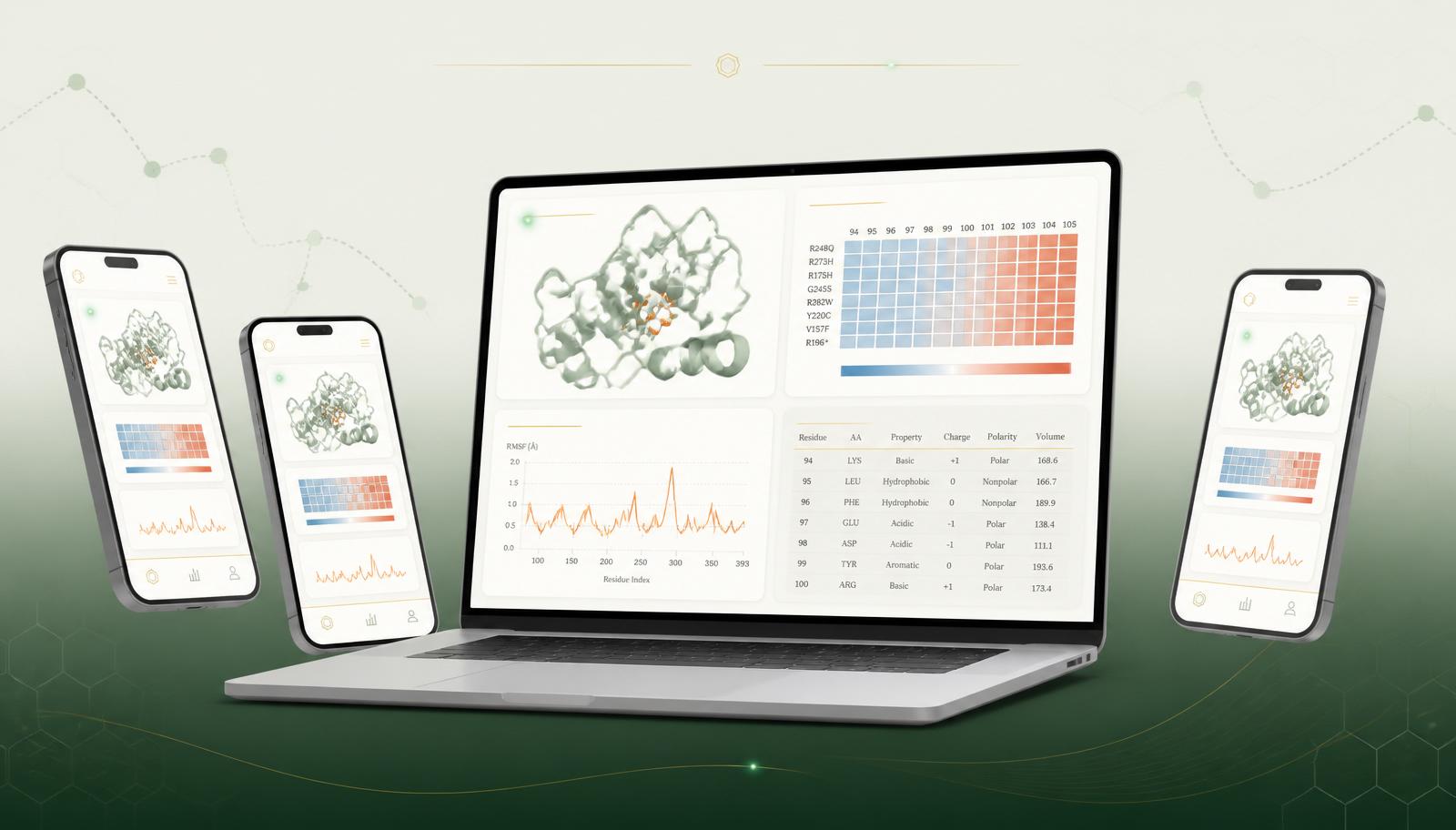
Zero-install pipeline
The workflow combines ESMFold structure generation, Mol* visualization, local docking, and ML scoring without desktop software.
Screen-first export
The report button now exports the currently visible lab state as detailed JSON, including card values, tables, links, and docking results.
Robust structure handling
Catalog PDBs, uploaded structures, WT overlays, and optional Mol* services are guarded so visualization and docking keep working when upstream services fail.
Built for speed. Honest about uncertainty.
TP53 mutation entries mapped from COSMIC into the Lovable Cloud catalogue
Vetted ChEMBL Phase-4 compounds indexed for the screening library
Curated rescue ligands docked and ranked sequentially in-browser
Structured export of visible cards, tables, links, viewer state and docking scores
Every layer, purpose-built
Docking and ML inference run in your browser via RDKit-WASM and ONNX. Structure prediction is served by ESMFold through our secure server layer, Mol* rendering is guarded against optional endpoint failures, and the lab can export its visible state as JSON.
- React 19 + TanStack Start — file-based routing, SSR-ready
- RDKit-WASM — cheminformatics + rigid-body docking in-browser
- ONNX Runtime Web — ensemble rescue classifier with isotonic calibration
- Mol* — guarded 3D structure, WT overlay and pocket rendering
- Supabase + pgvector — mutation catalogue, dockable receptors, RAG index
- Hosted AI gateway — grounded answers with citations
Ask questions. Get grounded answers.
The RAG pipeline combines pgvector semantic search over the curated mutation catalogue with a hosted LLM, so answers are grounded in the catalogue entries retrieved for each query rather than free-form generation. Literature embeddings are on the roadmap.
>What rescue compounds are curated for R248Q?
>Rank TP53 hotspots by dockable-pocket score.
>How do R175H and R273H differ mechanistically?
The road ahead
Beyond TP53
Extend the pipeline to TP63, TP73 and other tumor-suppressor targets that share the DBD structural family.
Active learning
Use the calibrated uncertainty to steer screening sweeps toward the poses the model is least sure about.
Community-labelled runs
Signed-in researchers can label dock runs as hit / miss to enrich the training set and lift AUROC.
Public askMutationLab API
Expose the RAG endpoint so external notebooks and pipelines can query the catalogue programmatically.
Ready to run a rescue on your mutation?
Sign in with your credentials — accounts are provisioned by the HyperLab53 team. No installs, no cloud credits.